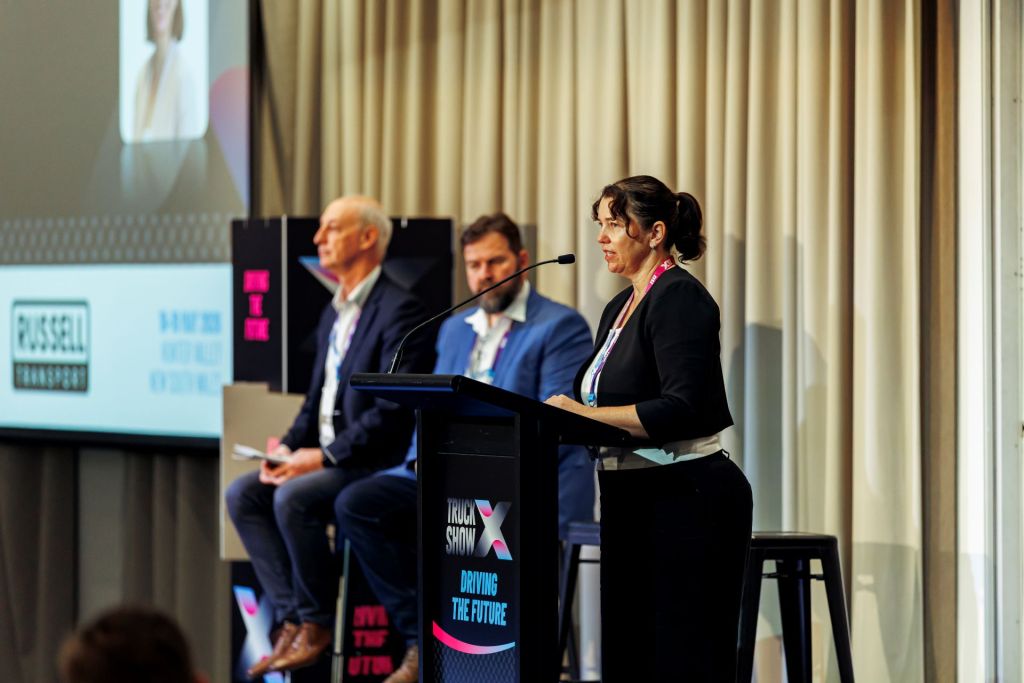
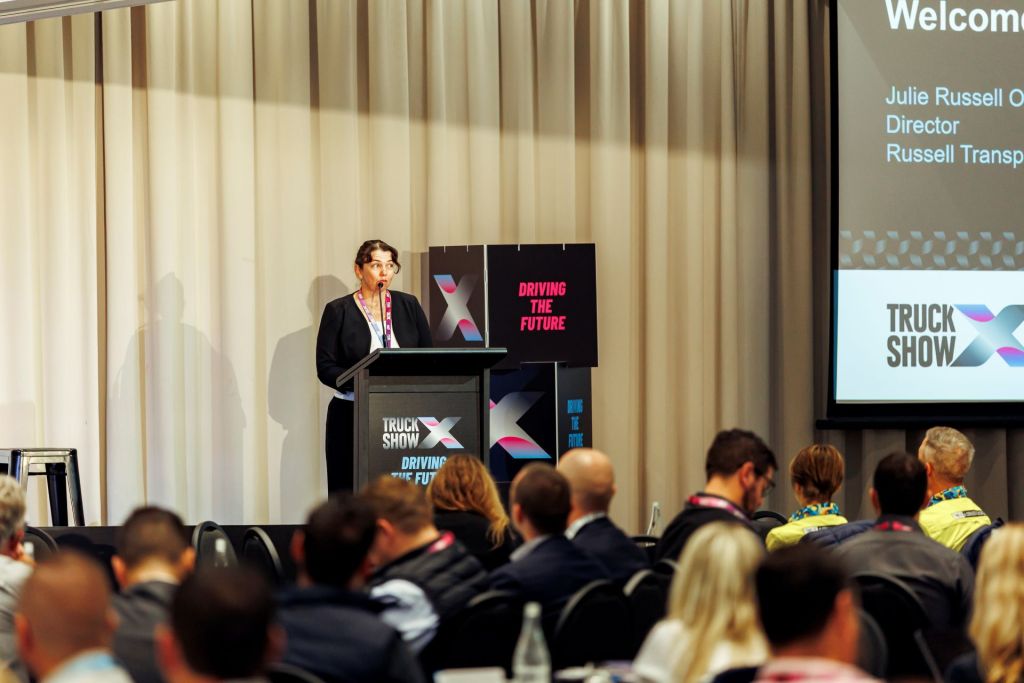
The pace of change facing transport operators is only going to accelerate, Julie Russell, a director and third-generation member of family-owned Russell Transport warned in her opening address to HVIA’s TruckShowX 2026 conference on May 18-19.
“When I reflect back across my time in the industry, I see a pace of change that appears to be getting faster, and disruptions that are both unpredictable and often occurring at the same time,” said Julie, who is also Deputy Chair of the National Heavy Vehicle Regulator.
“My family has been in the road transport industry for over 100 years, and in this time we have seen enormous change across the societal, cultural, political, regulatory and technological landscape.
“Even on the geopolitical front, there has been changes which has affected how we operate and how our supply chains function.
“My grandfather’s first key decision was whether to go with the new technology of the day or stick with the horse and cart. The advancement of our heavy vehicle fleet from that decision onwards has evolved and continues to evolve in regard to the size of the vehicle, the different makes, models, the products we carry, and even our employment structures.
“They all evolve as new technologies and standards were introduced.”
But the core focus of the business has never changed, Julie noted, and remained centred on “performing the task. The delivery itself”.
“If you look back in time, you can see we, as an industry, have always been evolving. And for the most part, the changes have been gradual, incremental, and most importantly, didn’t compound,” she added.
Among the biggest challenges confronting the industry, she believes, is not technological. It’s people. Specifically, a shortage of people with the skills and experience necessary to operate the equipment and technologies required to meet the ever-increasing demand for transport services.
“This has also driven our labour costs up,” she added, often without the ability to offset the increased costs with either rate rises or savings.
“While it might look like there’s plenty of work, there is still pressures that drive margins down, and there is a growing issue in some jurisdictions around road access,” Julie said.
“And while I can spend a lot of time referencing all the issues we’re facing around access and bridges, I would draw the point that limiting and continually changing access permissions puts significant operational pressures on carriers, particularly when large capital investments have been made upfront.”
While opportunities for savings are limited, operators are confronting rising costs across the board, from labour, and more recently fuel, to compliance with upcoming changes to the National Heavy Vehicle Law, she said.
“Many operators have needed to manage their cash flows in order to pay for the rising costs of fuel and to keep the wheels turning,” Julie said.
“And while many contracts have rise-and-fall mechanisms embedded into them, the delay in timing for when this can take effect has impacted many. Not to mention that businesses have to deal with this at the same time as the migration to Same Day Super.
“And I would also add a point on the war in Iran. We still probably haven’t seen the full long-tail effect of that and what it will have on our supply chains along the next few months to years.”

Julie suggested impending changes to the HVNL – in particular, accreditation schemes – may result in additional IT costs for some businesses that are seeking to maintain their additional mass and working hours arrangements.
As will mandatory reporting on emissions, which for large companies ($200 million+ annual revenues) has already come into effect, with the final group of companies (consolidated revenue of $50 million or more) due to commence reporting from July 1, 2027.
“The world of technology has come a long way in how it is used in our industry. It’s no longer the computer on a desk. It has evolved and continues to evolve at a rapid rate. And without good technology systems and data flows, businesses have increasing costs to manage the paper trail while trying to do so with staff shortage pressures,” she said.
“But with IT systems, there is a whole new set of costs and a level of knowledge that many transport businesses are not equipped to manage.
“Tomorrow’s transport company is looking more like a systems owner than a fleet owner. With AI use on the rise, most of the traditional scheduling, allocations, compliance, checks, vehicle monitoring, all that, they’re all evolving from the traditional structures.
“Depending on your fleet makeup, client needs and compliance programs you operate, you have to consider what system or systems will work best for you. Having a system that can be scalable to the variability of your fleet, while still allowing for an interface, a single point interface to view and extract the information, will be a challenge for many.
“Making the wrong decision on this is going to be very costly. But making no decision will have its own detrimental effect.
“And even if we are able to have more systems integrate together, there’s still the underlying issue of many transport companies being ill-equipped or lacking staff with the IT skills to bridge the knowledge gap.”
And just like her grandfather 100 years ago, operators like Russell Transport face their own “horse and cart” moment, Julie admitted.
“While some new technologies exist, most notably in electric vehicles, each operator will need to consider what options are available that may best fit their work tasks and the new costs of doing business with or without adopting alternative technologies for carbon reduction,” she said.
“There is a wide range of transport companies, each different and unique. The way they will approach the above will be slightly different for each, and I’m sure you can all envisage the various points and issues amongst your own networks.
“As new entrants come into the industry, they’ll have the opportunity to decide what new technologies they’ll start out with.
“But for now, I’m one of those businesses that is already in it. This time round, I have the horse and cart. And I, like many, am having to navigate a number of changes to the way we operate, including our fleet, our people, and the systems we use.”